
Digital Awareness for Kids: Preparing the Next Generation for a Connected World
- Life Champs
- Apr 20
- 2 min read

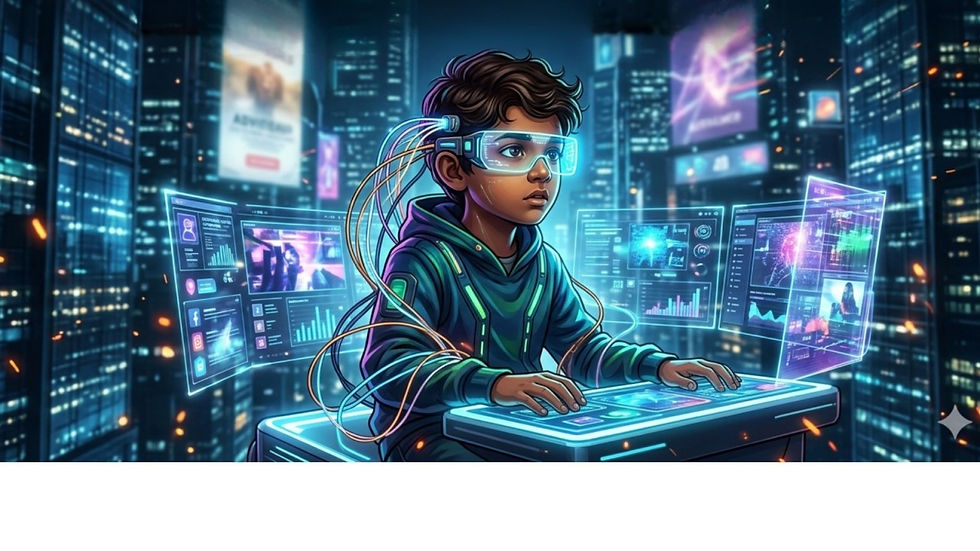
Did you know that Gen Alpha is the first generation in history to be born into a digital-first world?
From their earliest years, smartphones, tablets, and screens have been constant companions. While technology has unlocked unprecedented access to learning and creativity, it has also introduced a new set of risks—ones that previous generations never had to face at such an early age.
According to a report by NITI Aayog(https://niti.gov.in/sites/default/files/2025-06/Online-safety-for-children-protecting-the-next-Generation-from-harm.pdf), one in three internet users globally is a child, and their time spent online increases significantly with age. Children between 6–10 years already spend around 2.5 hours online daily, while teenagers can spend up to 6 hours a day . This growing digital exposure has led to a sharp rise in associated risks, including a 32% increase in cybercrime against children between 2021 and 2022 .
The challenges are not limited to screen time. Children today face multiple online threats:
Cyberbullying, impacting nearly 20% of children on social platforms
Exposure to inappropriate or harmful content
Risks from online predators exploiting anonymity
Privacy violations, where children unknowingly share sensitive information
The rapid spread of misinformation and fake news, which young minds struggle to evaluate
Beyond safety concerns, there is a deeper, often overlooked issue: digital overload. Human eyes and brains were not designed for continuous exposure to blue light and algorithm-driven content. The result is reduced attention spans, increased dependency on screens, and challenges in distinguishing between digital and real-world experiences.
However, the solution is not to eliminate technology. In fact, that would be counterproductive. Technology is here to stay—and it will only become more integrated into education, careers, and daily life. The real solution lies in Digital Hygiene.
Digital hygiene goes beyond basic safety. It includes:
Understanding how to use technology mindfully
Making smart choices online
Balancing screen time with real-world experiences
Learning to critically evaluate information
Using technology as a tool to create, not just consume
Education plays a crucial role here. As highlighted by global organizations like UNICEF(https://www.unicef.org/innocenti/documents/digital-literacy-children-10-things-you-need-know), digital literacy is no longer optional—it is a foundational life skill. Parents and educators must actively guide children, set boundaries, and create open channels of communication about online experiences. At the same time, children need relatable ways to learn these concepts starting at a young age. This is where storytelling and structured learning can make a powerful difference.
We at Lifechamps believe that engaging stories can help children understand topics like mindful technology use, screen addiction, online decision-making, and the balance between screens and reality. More importantly, it can show them how technology can be used as a force for good—encouraging them to build, create, and solve real-world problems instead of just scrolling.
In a world designed to capture attention, we must equip children to protect their focus, think critically, and navigate confidently.
Because digital awareness today is not just about safety—it is about preparing children for the future.
Comments